
Four DeSoto Release Dates
One sentence can produce several dates. The sentencing or commitment date begins the formal term. A parole-eligibility date marks the first point when the Mississippi State Parole Board may consider an eligible person. MDOC’s tentative date is a forecast based on the information and credit rules then entered. The actual release or discharge date records what happened.
Only the last date confirms that the custody episode ended. Eligibility is not a grant. A grant is not physical checkout. A tentative date can move. For a DeSoto County Adult Detention Facility episode, a filed court order explains the authority, while the Sheriff’s release entry documents when that order was carried out.
| Date | What it answers | What it does not prove |
|---|---|---|
| Sentence or commitment | When the term began | When confinement will end |
| Parole eligibility | When review may begin | A grant or release |
| Tentative release | Current MDOC forecast | Executed checkout |
| Actual release or discharge | When the agency ended the status | Freedom from every other hold |
Search DeSoto Release Dates
Use the custody path that fits the case. The MDOC inmate search covers people who entered state custody. Its controls include first name, last name, and MDOC ID. It is not a full archive of people held only at the DeSoto jail. If the ADF record says MDOC commitment or transfer, continue in the state search. If the person left on local bond or finished a county term, lack of an MDOC match is expected.
- Identify the custody episode through the DeSoto jail docket, court case, or MDOC number.
- For state custody, search MDOC and open the matching detail after comparing identifiers and sentence information.
- Read the exact field label and note whether the displayed date is in the future or past.
- For a county sentence, obtain the judgment and ask ADF for its existing computation or projected-release record.
- Check for detainers, amended orders, and parole action that could affect the result.
- Confirm the actual event with the custodian. For a broader person search, use the DeSoto County release-record path.
A name missing from the live county docket does not prove release. The Sheriff can confirm the date, public category, and whether another agency assumed custody. Give the full name, date of birth, booking number if known, and approximate booking date.
DeSoto Tentative Release Field
The MDOC detail template uses the exact label Tentative Release Date. Other displayed information may include the person’s MDOC number, photograph, Entry Date, Location, Unit, Location Change Date, sentence count and length, offense, county, and sentence date. Fields vary by record. Preserve the label instead of translating it into a guaranteed date.
An official live example can show a person at South Mississippi Earned Release Supervision with an ERS Location or Unit while the person remains in the inmate search. That means departure from a prison building is not always discharge from MDOC jurisdiction. ERS is a supervised sentence status, so the location and date must be read together.
The manifest capture of the official MDOC detail shows the tentative date and ERS context.
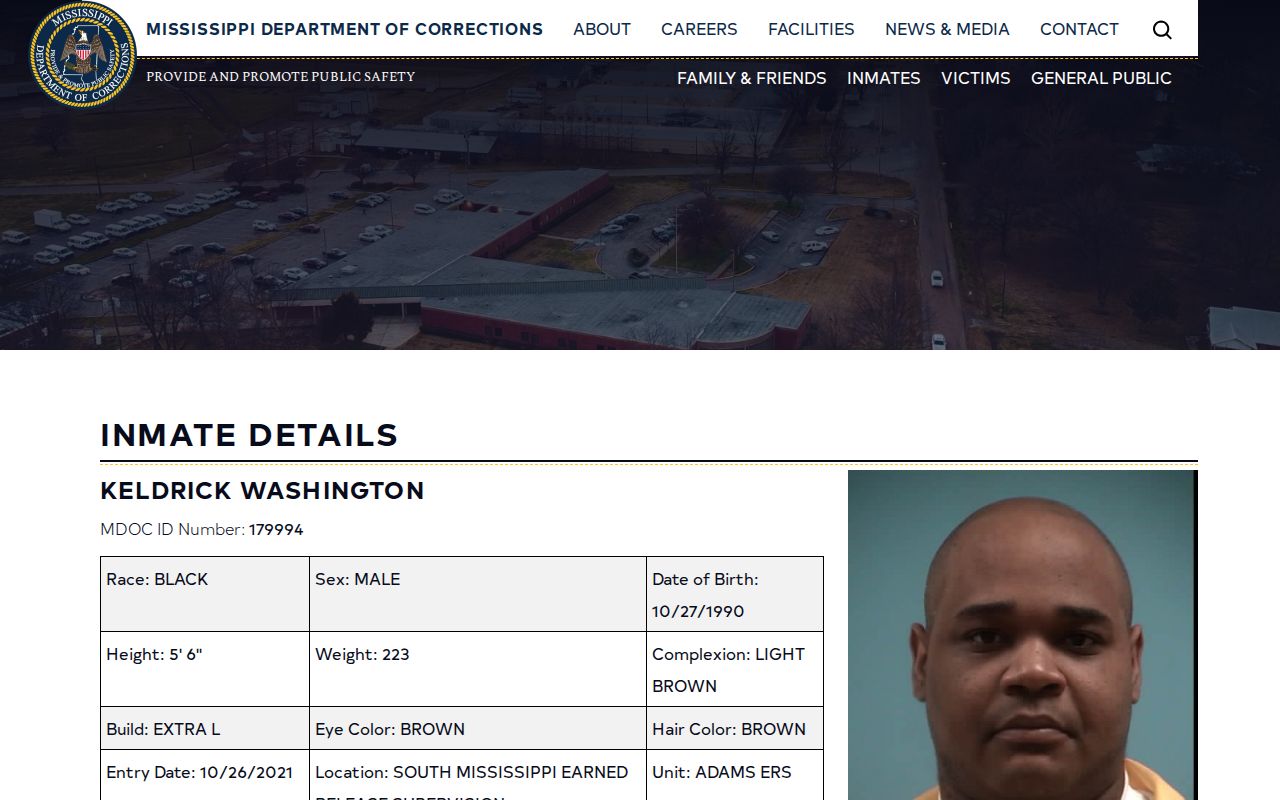
The image illustrates why one field should never be separated from the status, unit, and sentence data around it.
DeSoto Earned Release Rules
Mississippi Code § 47-5-138 and related Title 47 provisions govern earned-release mechanisms for eligible MDOC prisoners. For ordinary eligible post-June 1995 earned time, the cited rule caps earned time at 15 percent. Yet the familiar 85/15 shorthand is not a universal calculator. Offense date, offense category, exclusions, jail credit, trusty time, forfeiture, sentence structure, and later legal action all matter.
Use the current Mississippi Legislature code for the person’s sentence class. A calculation based only on the sentence length can be wrong. Concurrent sentences run together in a defined way, while consecutive sentences are served in sequence. A jail-credit correction can change the start point. An amended commitment may alter the legal inputs, and disciplinary forfeiture may alter credit.
Parole uses another framework, principally § 47-7-3. The parole-eligibility date is when the Board may consider a qualifying person. It is not the tentative discharge date, and some offenses or structures are excluded. Even after a grant, conditions and MDOC processing must be completed.
DeSoto County Jail Timing
County-jail timing cannot be derived from an MDOC field. A short DeSoto sentence may depend on the filed judgment, jail credit, lawful sheriff-administered credits, and any hold from another court or agency. A pretrial detainee has no sentence-based date at all. Bond may be set, but community release still depends on posting, processing, and the absence of a detainer.
Obtain the commitment or sentencing order from the court that owns the case. Then ask the DeSoto County Adult Detention Facility for the existing computation, projected date, or release entry for that booking. The ADF is at 3425 Industrial Drive W in Hernando. Its phone is 662-469-8566, and the general inmate-information line is 662-469-8500.
No verified DeSoto policy creates a universal weekend or holiday early-release rule. Do not assume a date that falls on Sunday becomes Friday. Confirm timing and pickup instructions with ADF because a court date, administrative processing, and another agency’s hold can all affect the outcome.
Why DeSoto Release Dates Move
A projected date changes when one of its legal or factual inputs changes. The reason should come from a time sheet, sentence computation, court order, Board record, or receiving-agency document. Guessing from a moved online date can confuse a routine recalculation with a new legal event.
| Factor | Possible effect | Record to check |
|---|---|---|
| Earned time | Credit awarded or forfeited | MDOC time computation |
| Jail credit | Start point corrected | Commitment and credit record |
| Court action | Sentence amended or vacated | File-stamped order |
| Sentence structure | Concurrent or consecutive terms reviewed | Judgment and computation |
| Parole | Eligibility, decision, and processing differ | Board action plus MDOC status |
| Detainer or hold | Pickup or continued custody follows | Sheriff and receiving-agency records |
A transfer closes one agency’s custody episode but does not establish community release. Follow the receiving agency until an executed release is documented.
DeSoto’s extradition process gives this issue a local form. An outside agency may lodge a detainer with ADF, and the Fugitive Division coordinates pickup after local charges finish. The published process ordinarily gives the agency ten business days to arrange transport, subject to exceptions. A person can leave the county roster on the expected day and remain confined elsewhere. Ask the Sheriff for the receiving agency rather than recording the event as release to the community.
DeSoto 85/15 Date Limits
The most useful local computation lesson is that an ERS participant can still appear in MDOC’s inmate system. A tentative date beside an ERS Location or Unit does not mean the sentence is over. It describes a current state record whose credits and status must be read as a whole.
Trusty time, jail credit, statutory exclusions, forfeiture, offense date, sentence form, and parole can all keep a simple 85-percent estimate from matching the official date. The public field is a clue, not a substitute for the agency’s time sheet. Request the public computation through MDOC’s records route when the displayed date cannot be reconciled with the sentence.
For a county-only term, omit the 85/15 shortcut entirely. The ADF and sentencing court are the proper sources. No source verified a DeSoto weekend adjustment, so any promised early release would be unsupported.
Confirm DeSoto Actual Release
A future alert can help with timing, but it does not replace the record. Mississippi SAVIN/VINE may report a participating agency’s release, transfer, return to custody, escape, or supervision event. Data can lag, and an alert is not guaranteed. A transfer alert means custody may continue.
After the projected day, ask the custodian for the actual release or discharge date. For MDOC, a focused request may seek the release entry, public time sheet, transfer history, and discharge certificate. For ADF, seek the jail-docket and release entry. For parole, compare the Board action with MDOC status. The VINE Inmate Check explains the notification layer without treating it as legal proof.
Record the source and the date checked. If two agencies disagree, ask each to reconcile the named field instead of selecting the more convenient answer.
When the active MDOC search no longer returns a useful record, the historical fallback is a written request. Mississippi rules describe an Inactive Master File for people discharged at expiration or finished with parole, probation, post-release supervision, and other MDOC statuses. Ask for the public actual-release date, release mode, time computation, and discharge certificate tied to the MDOC number. No verified rule promises that the same information will remain online for a fixed period.
The court file completes the chain. A filed sentence, amended commitment, revocation, or discharge order can explain why the computation changed. The court does not maintain a universal release list, so the agency record still proves execution. Match the case number, MDOC number, and booking number to avoid combining people with similar names.