
Where Federal Releases Go
BOP operates or contracts federal prisons across the country. A person with a DeSoto County tie may serve a federal sentence far from Mississippi. Leaving a BOP institution can mean community release, transfer to another authority, or another change in legal custody. The public result must be read as a BOP record, not a statement about all government systems.
A historical locator result commonly provides a release date and a phrase indicating the person is not in BOP custody. That establishes the end of BOP custody shown by the locator. It does not rule out a state prison, county jail, USMS transport or pretrial custody, or ICE detention. The receiving source must be checked when the federal or local record indicates a handoff.
| Federal source | Coverage | Key limit |
|---|---|---|
| BOP locator | BOP federal custody and historical results | Not a universal federal or local locator |
| USMS | Federal pretrial prisoners and transport | No matching general public historical locator |
| ICE ODLS | Some current immigration detention | No result does not prove release |
| DeSoto Sheriff | Local booking and transfer episode | Cannot establish later federal release alone |
Confirm a Federal Release
Use the BOP Inmate Locator for a person who served a sentence in BOP custody. An agency identifier gives a safer match than a name alone. The locator accepts a BOP register, DCDC, FBI, or INS number; it also offers a name search with demographic filters.
- Search by federal identifier when one is known, or use the full name and offered filters.
- Match the register number and demographic fields rather than relying on the name alone.
- Record the release date and status phrase exactly as BOP displays them.
- Check the federal court file for the judgment and later orders that explain the sentence.
- Use BOP records procedures when the locator lacks the historical detail needed.
If the DeSoto ADF record says the person went to USMS, BOP may not yet be the correct system. The DeSoto County release-record search can establish the local handoff, but only the federal custodian can establish the later federal event.
BOP Release Records Contact
BOP's locator is the public starting point. For records beyond the display, follow the agency's Freedom of Information Act and Privacy Act instructions. Describe the existing record sought and identify the person with the register number, full name, and date range. Do not send a federal request to the DeSoto Sheriff unless the desired record is the local booking or transfer entry.
Federal Bureau of Prisons
Nationwide federal prison system
A request can seek a public historical custody or release document when the locator is incomplete. Access and redaction depend on the requester's authority, the record, and federal law. The public locator itself has historical-coverage limits, so an absent result should not be turned into a claim that no federal custody occurred.
BOP Federal Release System
The Facility Map includes BOP because federal custody can follow a case or transfer connected to DeSoto County. It does not identify a BOP institution in DeSoto County. Federal prisons nationwide form the relevant system, and a person's designated institution depends on federal custody administration.
The county jail docket is useful for a local episode. A notation showing release to USMS or another federal authority means the Sheriff stopped holding the person, not that all custody ended. Conversely, BOP's “not in BOP custody” phrase does not resolve a later county arrest or a separate state sentence. Keep each custodian's date tied to its own episode.
View the BOP Release Locator
The official BOP locator explains its identifier and name-search routes and returns federal custody history when a covered match exists. It is the proper public tool for a former BOP prisoner.
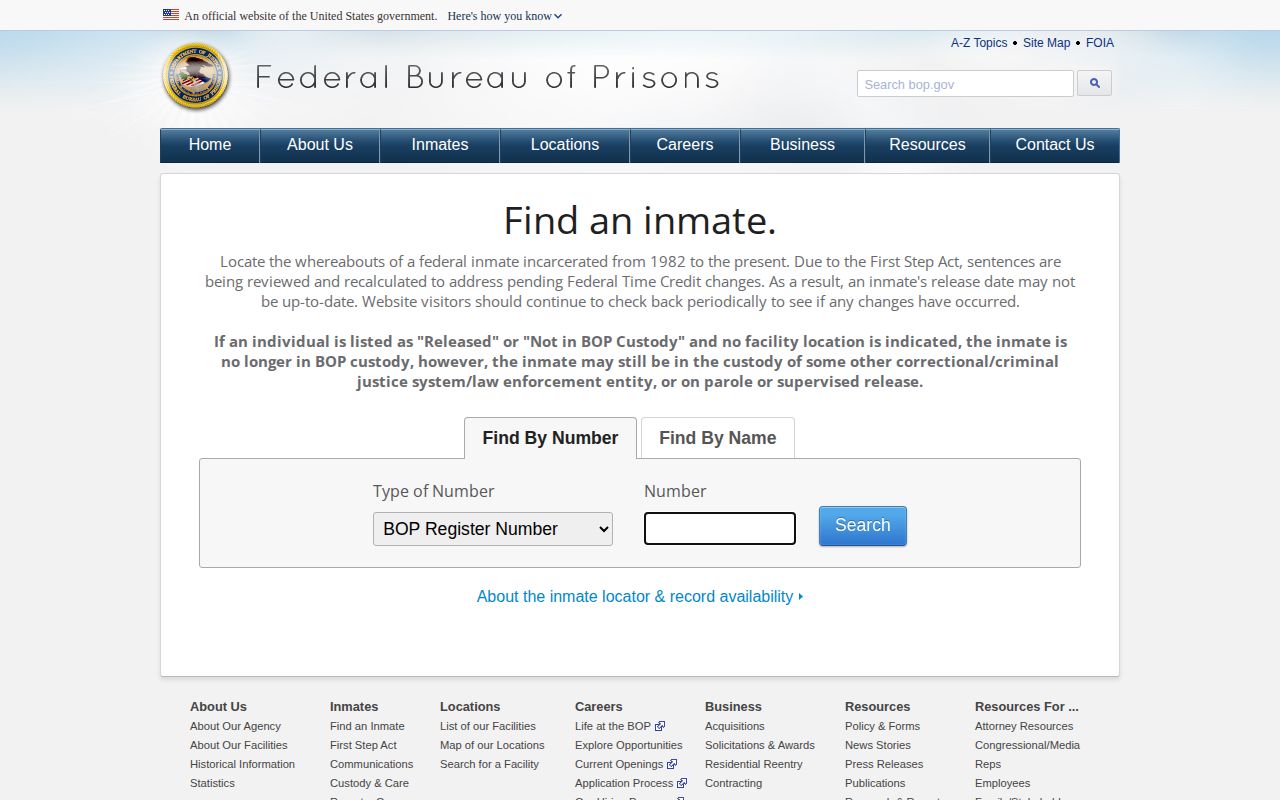
The captured locator supports the federal search path. It does not extend BOP coverage to local, state, USMS, or immigration custody.
USMS Federal Release Boundary
The U.S. Marshals Service manages many federal prisoners during pretrial proceedings and transportation. It does not provide the same broad public historical locator as BOP. A person can therefore be in federal custody without a useful BOP placement or locator result at that stage.
Use the federal court docket, counsel or clerk channels, and the appropriate USMS contact. A federal judgment explains sentence authority, while the responsible custodian establishes location and movement. Do not infer community release from a gap between the county docket and a later BOP result.
ICE Federal Release Boundary
An ICE detainer may lead to pickup after local charges end. The ICE Online Detainee Locator System uses either A-number and country of birth or full name, date of birth, and country of birth. It is aimed at locating some people in current immigration detention, not proving a complete historic release sequence.
Some people and cases do not appear, including excluded categories. A no-result response does not prove release or removal. If the DeSoto record shows an ICE pickup, identify the county event as a transfer and follow ICE contact information. Never speculate about status from a person's name, language, or birthplace.
Trace DeSoto Federal Releases
A reliable chain starts with the DeSoto booking number and release or transfer entry. The federal court case number connects the charge, detention order, judgment, and later filings. A BOP register number then links the sentenced federal term to the locator result. These identifiers prevent two people with the same name from being combined.
Read each verb literally. “Released to USMS” means a transfer. “Sentenced” does not prove arrival at BOP. A BOP release date establishes the event in BOP's system, while “not in BOP custody” describes current BOP status. If another hold appears, continue with the named agency before describing a community release.
Build Federal Release Proof
The best record set answers who was held, which federal episode is at issue, when BOP custody ended, what legal authority controlled it, and whether another custodian took over. The locator gives a useful historical result, while the court file explains the sentence. A written BOP record can resolve fields not present on the public screen.
Keep the date of each search because dynamic results are snapshots. When agency records conflict, ask about the exact identifier, date, or status phrase. Do not choose the most convenient source. A qualified finding such as “released from BOP custody on the displayed date; later custody not established” is more accurate than the broad word “free.”
BOP Historical Record Limits
The BOP locator explains that its historical coverage has limits. Older cases, people who never entered BOP custody, and federal defendants still managed by USMS may not appear as expected. Spelling and identifier errors can also hide a match. A no-result screen should lead to the federal court file, agency contact, or a focused BOP records request, not a claim that no federal imprisonment occurred.
The federal court record supplies the indictment, detention orders, judgment, and later filed action within that case. It does not serve as a prison checkout log. BOP supplies the custody and release record for its own term. When a sentence includes supervised release, that court-imposed phase is separate from BOP confinement and should not be described as continued prison custody.
For privacy and accuracy, search with the register number when possible and avoid combining similar names. Preserve the exact result and access date. If the public display does not answer the question, request only the needed record or field. A concise request tied to one person, identifier, and term is more likely to produce a clear, reviewable response.