
DeSoto Parole and Probation
Parole and probation both allow a person to live in the community under rules, but they arise in different ways. The Mississippi State Parole Board decides parole. Parole follows a prison sentence and a grant still must be followed by MDOC release processing. Probation comes from a court sentence and may begin without time in a state prison. MDOC Community Corrections administers field supervision for both statuses, along with earned release supervision and Interstate Compact cases.
A court order, MDOC profile, parole record, and office assignment answer different questions. Read the exact status and date. A hearing date is not a release date, and a favorable vote is not proof that physical release took place. Likewise, assignment to the DeSoto office confirms a supervision relationship, not the date or reason someone left the county jail.
| Point | Parole | Probation |
|---|---|---|
| Authority | Mississippi State Parole Board | Sentencing court |
| When it starts | After prison release processing | As ordered by the court |
| Local administration | MDOC Community Corrections | MDOC Community Corrections |
| Best proof | Board action plus MDOC status | Filed sentence order plus MDOC assignment |
- Parole
- Conditional community release from a prison sentence after Board action.
- Probation
- A court-ordered community sentence or suspended part of a sentence.
- Discharge
- The formal end of the relevant sentence or supervision term.
- Absconder
- A person officially reported as having left supervision without authorization. It should not be inferred from a missed contact.
Check DeSoto Post-Release Supervision
Begin with a sound identity match. The MDOC inmate search accepts first name, last name, or MDOC ID. The separate MDOC parolee search also offers city and county fields. DeSoto is one county choice. A parolee detail may include MDOC ID, county, supervising officer, Flat Time Date, and a photograph. Flat Time Date is a sentence-end field, not the prison checkout time.
There is no verified general public probationer search equal to the parolee search. For probation, use the sentencing order and ask MDOC to confirm the public office assignment. A person with a county-only jail stay may never appear in MDOC. The complete release-record path for that situation remains on the DeSoto County released-inmate search.
- Collect the full name, date of birth, MDOC number if known, and the court case number.
- Search the MDOC inmate and parolee systems, then compare the identifiers and read each label literally.
- For claimed parole, obtain the official Board action and compare it with MDOC custody or supervision status.
- For probation, review the filed sentence or revocation order from the court that owns the case.
- Confirm the assigned field office with MDOC. Do not assume a DeSoto address guarantees a DeSoto assignment.
- Request the underlying public record when the online profile is incomplete or ambiguous.
Important: A public search is a snapshot. MDOC or the record-owning court provides the authoritative supervision status and dates.
DeSoto Supervision Office Details
DeSoto County has a named MDOC Community Corrections field office. It is not a jail and not an MDOC prison. The distinction matters. A released state prisoner assigned to parole or earned release supervision may report there. A person sentenced straight to probation may also report there without having served a state-prison term. Conversely, a person leaving the DeSoto County Adult Detention Facility on bond is not automatically connected to this office.
DeSoto Probation & Parole Office
2865 Highway 51 South
Hernando, MS 38632
Phone: 662-429-3917
Fax: 662-429-0853
The manifest capture of the official DeSoto office page shows the state source that should be checked before making contact.
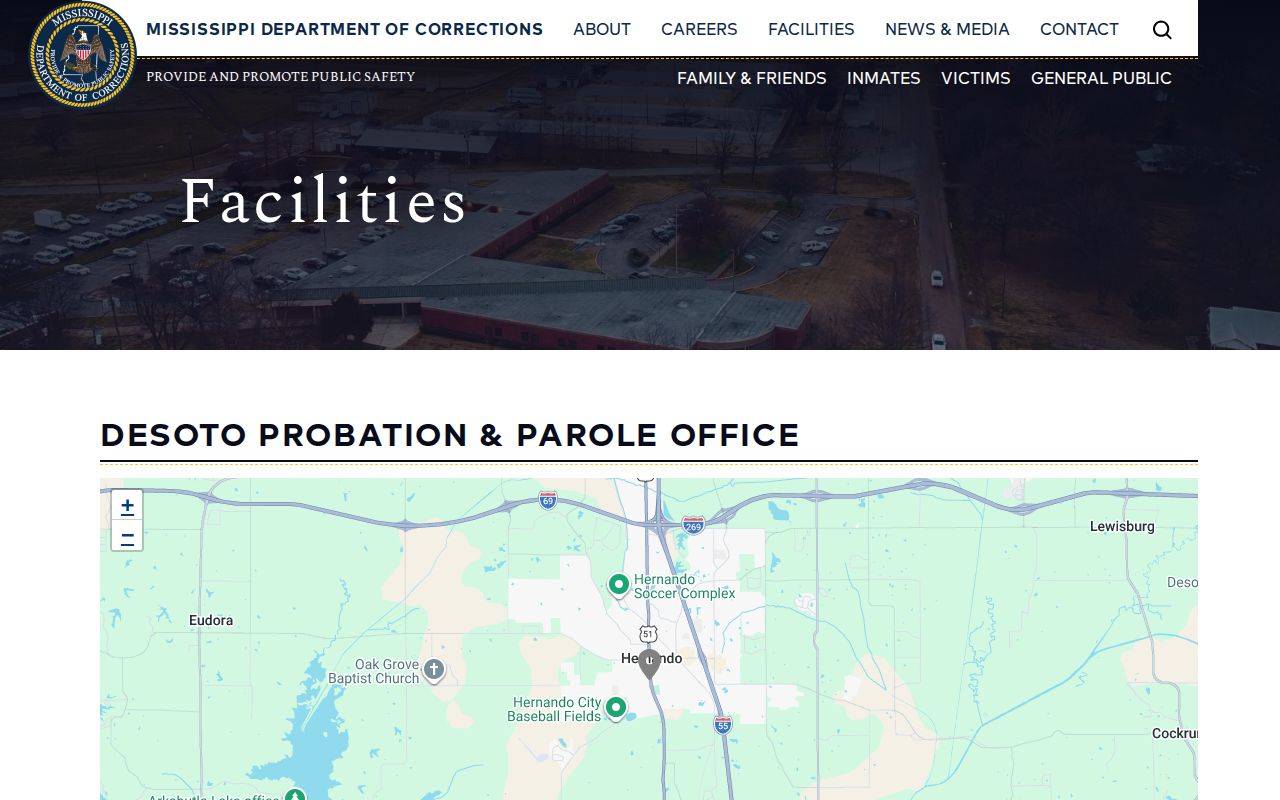
The office listing supplies a local route, but only MDOC can confirm whether this office holds the specific assignment.
DeSoto Parole Decision Records
The Mississippi State Parole Board makes parole decisions while MDOC carries out custody and field supervision. No current official public hearing calendar or online decision-results search was verified. MDOC notes that an eligible-person list is generated monthly and sent to the Board, but that internal step is not a public calendar or a promise of release.
For an individual, ask the Board for the scheduled hearing date and official action using the full name and MDOC number. Mississippi Administrative Code Title 29, Part 201 governs the route. Rule 2.3 addresses notice and case-by-case access, Rule 2.4 describes the minute-book copy of Board actions and reasons, and Rule 2.6 provides a records-request path. The supported outcome concepts are grant, deny, and revocation. Do not assign another label unless it appears in the produced record.
The Board’s current contact appears in the MDOC directory: 239 North Lamar Street, Suite 501, Jackson, MS 39202, phone 601-576-3520. Eligibility under Mississippi Code § 47-7-3 depends on the offense, sentence, dates, exclusions, and later amendments. Eligibility only means consideration can begin.
Board records and field-office records serve different roles. The Board record states the official action and releasable reasons. MDOC records show the later custody or supervision status. A DeSoto office listing identifies a place, not an individual assignment. If dates conflict, cite the precise field and ask the responsible agency to reconcile it. That avoids turning a planned hearing, a conditional grant, or an office address into an unsupported claim of release.
DeSoto Releases With Detainers
A local warrant or detainer can explain why a person leaves the DeSoto jail docket yet does not enter the community. The Sheriff’s official extraditions page says an outside agency may send a warrant or detainer to the Adult Detention Facility booking desk. The Sheriff’s Fugitive Division then coordinates pickup.
The published process ordinarily gives the outside agency ten business days after the DeSoto charges finish to arrange transport, subject to exceptions. That is a transfer of custody, not a release from all confinement. Verify the DeSoto episode with the Sheriff, then identify the receiving agency. The Fugitive Division is at 3091 Industrial Drive W in Hernando, phone 662-469-8524, with stated weekday office hours from 8 a.m. to 5 p.m.
An absconder issue is separate. Do not infer one because the person cannot be reached or missed an appointment. Use an official MDOC status, warrant, court order, or law-enforcement record. Mississippi SAVIN/VINE may report an absconding event from supervision, but its event is a notification layer rather than the legal warrant record.
Property After DeSoto Release
Post-release issues can begin before supervision reporting. The current DeSoto ADF handbook separates personal property from commissary after a transfer or release. For a transfer, limited property may accompany the prisoner. The handbook calls for a property-release form and an authorized recipient for other personal items.
Unclaimed personal property has a stated 30-day disposal point. Commissary left behind follows a separate 14-day rule and becomes Sheriff’s Office property under the handbook. Those are distinct categories. The deadlines should not be merged, and the supervision office should not be treated as the property custodian. Questions about ADF property belong with the Sheriff or ADF, while questions about reporting and supervision belong with MDOC.
This practical split also prevents an incorrect status claim. Property pickup does not prove parole, probation, or discharge. It only documents who may receive belongings and when.
DeSoto Supervision Discharge Records
Supervision ends through an official discharge, expiration, court action, or another status-specific process. A person may leave prison on parole and remain under conditions for years. Another person may finish probation without ever entering prison. The final record should identify the status, effective date, and authority rather than using “released” for every milestone.
If an active public lookup no longer helps, request the relevant record through MDOC’s public-record route. Mississippi’s records rules describe an Inactive Master File for people who have completed parole, probation, post-release supervision, earned-release status, or other MDOC matters. A focused request can seek the MDOC ID, public custody history, actual release or discharge date, release mode, time computation, and discharge certificate. No numeric online-retention period was verified.
Ask for electronic copies and a cost estimate. Protected portions may be redacted while public portions are produced. A custodian response is stronger than an old screenshot because it can identify the effective discharge date and the record used to establish it.
Keep the four milestones separate: Board eligibility, Board action, physical release, and final discharge. They can occur on different dates and are proved by different records.