
DeSoto Supervision After Release
The DeSoto Probation and Parole Office is an MDOC Community Corrections field office. A released state prisoner may report there while on parole, earned release supervision, or another MDOC status. A court can also impose probation without a state-prison term. In either case, reporting to this office means community supervision, not detention at the Highway 51 address.
Parole is conditional community release from a prison sentence after Parole Board action and MDOC processing. Probation is a court-ordered community sentence or suspended part of a sentence. Discharge or expiration means the relevant term has ended. These labels should not be merged, since each points to a different decision record and different date.
| Status | Decision source | What it proves |
|---|---|---|
| Parole | State Parole Board and MDOC | Conditional release and supervision, after processing |
| Probation | Sentencing court | Community sentence; prison may never have occurred |
| Earned release supervision | MDOC record and law | Community phase under MDOC jurisdiction |
| Discharge | MDOC or court record | Completion of the stated term |
Verify DeSoto Supervision Records
Begin with the MDOC inmate search when the person entered state custody. Search by first name, last name, or MDOC ID and preserve the identifier. Read the Location, Unit, status, sentence fields, and Tentative Release Date exactly as displayed. A person in an earned release program can remain under MDOC jurisdiction after leaving a prison building.
- Confirm the MDOC number and match the record to the correct person.
- Read the public status and location without converting a tentative date into an actual release.
- Use the separate MDOC parolee search if parole is claimed, including its county field.
- Compare a Parole Board decision or court order with the MDOC custody and supervision status.
- Contact MDOC or the listed field office for appropriate public assignment confirmation.
No general public Mississippi probationer search was verified. A negative parolee-search result does not disprove probation or another status. For a county-jail release date, use the DeSoto County release-record route, because the field office does not establish when the ADF executed a release.
DeSoto Supervision Office Contact
The official MDOC facility directory identifies the Hernando office and its county assignment. A public call can help confirm the right office or route a records question, but callers should not assume a person is supervised there solely because the person lives in DeSoto County. Assignment depends on MDOC and case administration.
DeSoto Probation & Parole Office
2865 Highway 51 South
Hernando, MS 38632
Telephone: 662-429-3917
Fax: 662-429-0853
The Mississippi State Parole Board makes parole decisions, while MDOC administers field supervision. For an individual hearing or decision, use the current Board contact in MDOC's directory. No official public hearing calendar or online decisions search was verified, so a claimed date should be checked through the Board record.
DeSoto Supervision Office Role
The office does not hold people overnight and does not issue county-jail release entries. Its facility listing is part of the statewide community corrections network. A person can be sent here after a state release, but the office can also supervise direct probation. That is why its records cannot answer every question about where or when confinement ended.
If an ADF record says “MDOC” or state commitment, follow the person into the statewide MDOC search. That county departure is a transfer, not community release. If the ADF record instead shows local bond, time served, or a court-ordered release, the absence of an MDOC result may be entirely expected.
View DeSoto Supervision Records
The official MDOC DeSoto office listing supplies the local address, telephone, fax, office type, and county. It is the proper source for the field office's current public contact details.
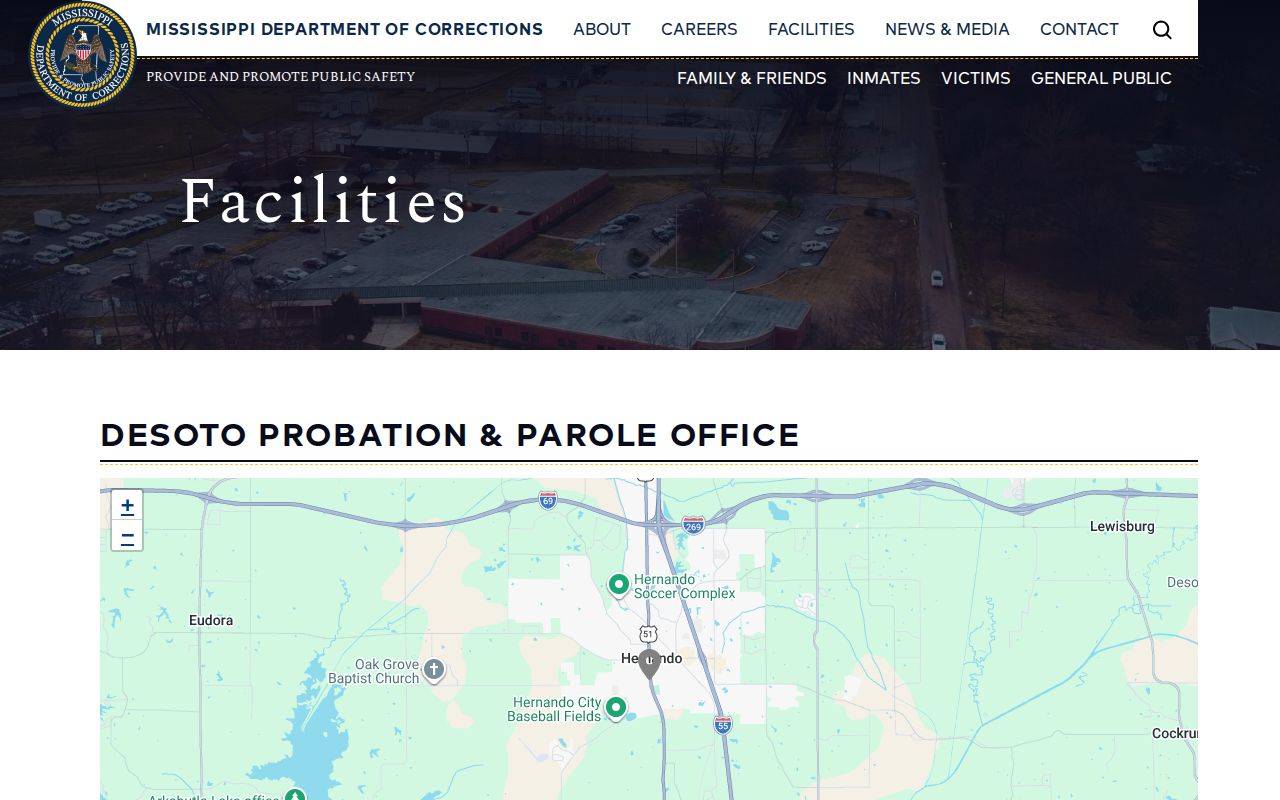
The captured page confirms a community corrections office. It does not show that a named person is assigned there or supply an executed release date.
Read DeSoto Supervision Dates
Several dates can appear in a supervision record. A parole eligibility date marks the earliest point at which a qualifying person may be considered. A favorable Board action still is not the physical release time. A Tentative Release Date is a forecast that may change. The MDOC parolee search can display a Flat Time Date, which is a sentence-end field rather than the date a person walked out of prison.
Use an actual release or discharge entry for the event that happened. Compare it with the Board decision, court order, and status. Credits, forfeitures, amended orders, detainers, revocation action, and data updates can change the path. One field should not be forced to answer all four questions.
DeSoto Supervision Warrants
An absconder is a person whom the responsible agency officially identifies as having left supervision without authorization. Missing an appointment, failing to answer a call, or being hard to find does not establish that status. Use an official MDOC warrant or absconder record or a law-enforcement source before applying the term.
DeSoto's Sheriff separately publishes a detainer and extradition process. An outside agency can arrange pickup after local charges finish, which may explain why a person left the county roster but never reported in the community. This is a custody transfer issue, not proof of a supervision violation. Match the warrant, booking, and MDOC identifiers before connecting records.
MDOC Inactive Release Files
A fully discharged person may no longer yield a useful active public result. Mississippi's MDOC records rules define an Inactive Master File for people discharged at expiration or finished with parole, probation, post-release supervision, shock probation, and other supervision. That archive provides a local fallback when the public search no longer explains a completed DeSoto matter.
Request existing records in writing through MDOC's public-record route. Identify the person by MDOC number, name, date of birth, and date range, then ask for specific public fields such as actual release or discharge date, release mode, supervision history, or discharge certificate. No permanent retention period was verified, and fees depend on the request, so ask for electronic copies and an estimate.
How DeSoto Supervision Ends
Community supervision does not end merely because a person stops appearing at an office or because a projected date passes. The controlling record may be an MDOC discharge, expiration entry, Parole Board action, or court order, depending on the status. A revocation can instead return a person to custody. Read the actual outcome and date rather than inferring completion.
Parole decisions and physical release are distinct. The Board may grant parole, deny it, continue consideration, or impose a next action, while MDOC handles the later release process and field supervision. No verified public decisions portal supplies every individual result. When an exact outcome matters, request the Board record through its published rules and compare it with MDOC status.
Probation can end through completion, discharge, modification, or court action. Since no general public probationer lookup was verified, the sentencing court and MDOC records route may both be needed. The local office can route appropriate public questions, but it should not be asked to disclose protected case-management detail. A final discharge record is stronger proof than silence from a public search.