
DeSoto Juvenile Release Boundary
The DeSoto County Juvenile Justice Facility is a restricted-access juvenile detention setting. It is not an adult county jail, a state prison, or a public name-search source. A youth may leave under a Youth Court order, return to a parent or guardian, enter an authorized placement, or move under another lawful direction. The exact destination and terms belong to the authorized case process, not a public released-inmate listing.
That distinction protects both accuracy and confidentiality. A missing adult JailTracker result says nothing about whether a youth was detained, moved, or released. Mississippi VINE, the MDOC inmate search, and the Federal Bureau of Prisons locator are also not substitutes for a juvenile case channel. Public pages should never expose a juvenile identity or imply that an adult release record exists.
Confirm an Authorized Juvenile Release
A parent, guardian, attorney, or other authorized party should begin with the facility or Youth Court. Staff may need to verify the caller's identity, relationship, and right to receive information before discussing a youth. The person asking should use the child's correct legal name and the case number when available, but should not place private facts in an open web form.
- Call the facility and state the authorized relationship to the youth without disclosing more information than staff requests.
- Ask which Youth Court or facility office owns the specific record or release instruction.
- Provide proof of identity and authority through the secure method the agency designates.
- Request the existing order, notice, or permitted record rather than asking staff to create a public narrative.
- Follow the court or facility's current pickup, placement, and confidentiality instructions.
The adult DeSoto County release search remains the right route only for adult jail, state, or federal custody. It must not be used to infer anything about a child.
Juvenile Release Contact
The county's official facility page provides the public contact point. Calling does not guarantee disclosure. It lets staff route an authorized party, explain what proof is required, and identify whether the facility or Youth Court controls the requested item. Office hours are stated for ordinary administrative contact and should not be treated as a public release schedule.
DeSoto County Juvenile Justice Facility
311 W South Street, Suite A
Hernando, MS 38632
Telephone: 662-469-8552
Fax: 662-469-8559
Office hours: Monday through Friday, 8 a.m. to 5 p.m.
Urgent pickup or case directions should come from the authorized agency contact, not from a general timetable. The research did not identify a routine public exit point, daily release hour, family waiting area, or transportation program for juvenile releases. Do not infer those details from adult ADF practices.
DeSoto Juvenile Release Profile
DeSoto County says the Juvenile Justice Facility opened in 2007 and has a capacity of 40. Those facts describe the building and its local role. They do not reveal the number of youths currently present, annual admissions, or releases. No population count should be inferred from capacity, and no youth-level detail belongs in a public summary.
The county's facility entry also establishes that this is part of local detention services. Its inclusion in the DeSoto facility map prevents a more serious error: treating every custodial site as though it shared the Adult Detention Facility's public docket. The juvenile boundary is a key facility fact, not a missing feature.
View DeSoto Juvenile Records
The official DeSoto County facility page is the source for the public address, telephone, hours, capacity, and access boundary. The successful reference capture below shows the county-managed information page rather than a youth roster or case result.
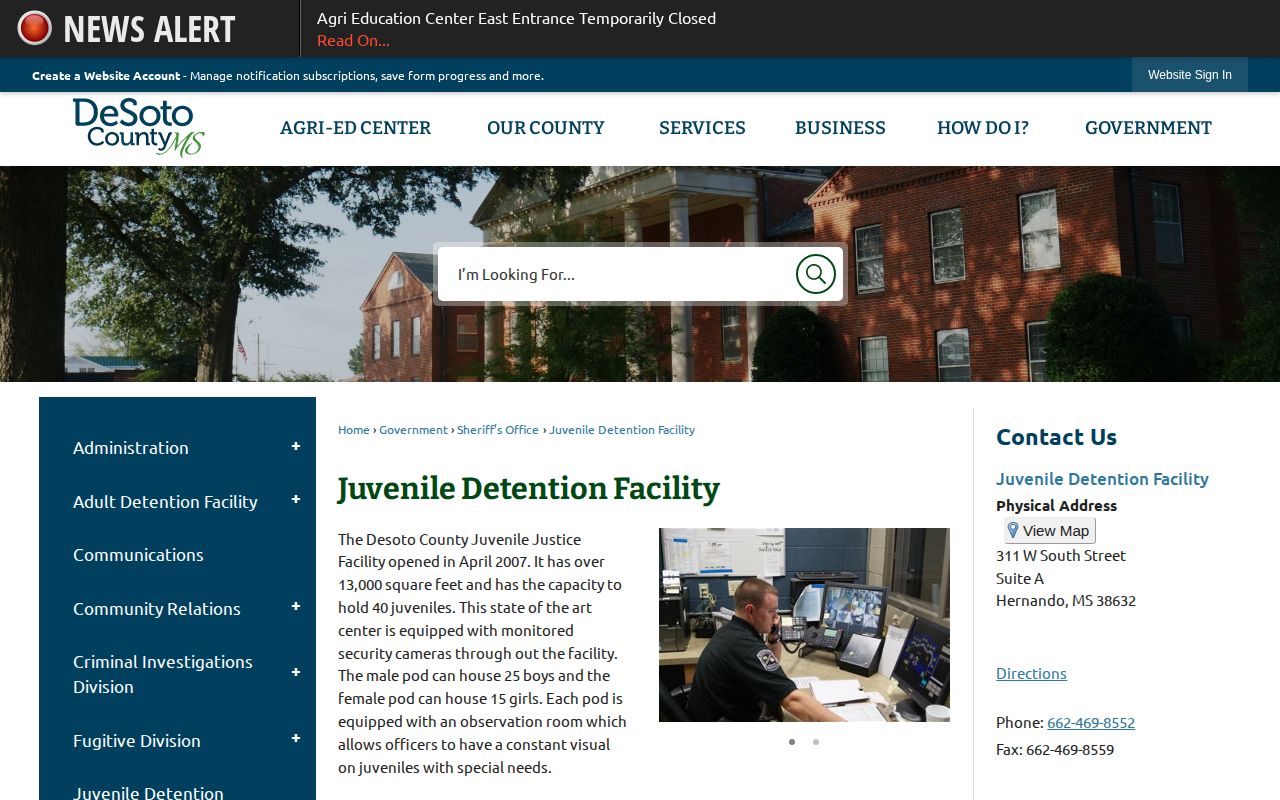
The image supports facility-level contact and access facts only. It should never be read as permission to search, publish, or confirm the identity of a child.
Juvenile Record Access Limits
Mississippi's Public Records Act and DeSoto County's request policy do not make every government-held item public. Juvenile and Youth Court material can be restricted by other law, along with sealed, medical, security-sensitive, personally identifying, victim, and active-investigation content. A broad public-record request cannot erase those limits. The custodian may verify authority, redact protected facts, or deny access with a legal basis.
An authorized request should identify the existing item sought, such as a permitted order or notice tied to one case. Ask for nonexempt portions only when that is lawful and useful. Do not ask for a public list of youths released during a date range. The research found no such official DeSoto feed, and creating one would conflict with the facility's access boundary.
| Source | Proper use | Boundary |
|---|---|---|
| Facility | Authorized custody and pickup routing | Identity and relationship may be verified |
| Youth Court | Authorized orders and case direction | Records are not an adult public docket |
| Adult JailTracker | Adult ADF booking information | Does not cover juvenile detention |
DeSoto Court Routes Differ
DeSoto County does not use one unified court search for all matters. Circuit, County, Justice, municipal, and Youth Court records follow different rules and systems. The county's public Online Records hub is useful for adult Circuit, Justice, and Sheriff routes, but its adult-facing links do not convert Youth Court information into public case data.
Ask staff which court owns the matter. Do not use a similarly named adult case to fill gaps, and do not assume that an absent public docket means no juvenile proceeding exists. A court order may govern a youth's placement or release, while the facility handles operational instructions. Authorized parties should reconcile those two sources privately.
Describe Juvenile Release Carefully
Words carry extra weight here. “Released from the facility” may describe the end of one placement, but it does not disclose where the youth went or whether another authorized placement began. “Transferred” should not be changed to “free.” A court order and facility record must be read according to their actual terms.
No public page should pair a juvenile name with charges, a photo, detention dates, or release details. Even a fact learned elsewhere should not be folded into the adult search path. The accurate public statement is narrow: DeSoto County operates a juvenile facility, its public contact details are available, and case-level access belongs to authorized facility and Youth Court channels.