
Where MDOC Releases Go
MDOC operates a statewide network of state prisons, regional correctional facilities, state-authorized county facilities, and community supervision. It is not a single DeSoto County prison. A person transferred from the DeSoto Adult Detention Facility to MDOC remains confined, even though the county jail episode ends. Later movement to parole, earned release supervision, or discharge belongs to the state record.
After leaving a prison building, a person may return to the community under MDOC jurisdiction, report to a field office, transfer to another authority, or complete the sentence. A release status should be copied as MDOC labels it. “Parole” and “earned release supervision” both involve community control, while “discharge” or expiration can mark completion. Another detainer can prevent a community return.
| Event | Custody meaning | Best record |
|---|---|---|
| ADF to MDOC | State custody continues | County transfer entry plus MDOC profile |
| Prison to ERS | Community phase under MDOC jurisdiction | MDOC location, unit, and date fields |
| Parole | Conditional release after Board action | Board record and MDOC status |
| Discharge | Named state term or supervision ends | MDOC executed record or inactive file |
Confirm an MDOC Release
Open the MDOC inmate search and use first name, last name, or MDOC ID. A common name can produce the wrong person, so preserve the MDOC number and compare the offense, county, sentence, and physical descriptors. Report only fields displayed for the matched record.
- Confirm that the DeSoto jail record actually shows commitment or transfer to MDOC.
- Search the state system with the narrowest reliable identifiers.
- Read Location, Unit, Entry Date, sentence fields, and Tentative Release Date exactly.
- Use the separate parolee search when the claim involves parole.
- Request the executed release, discharge, or time-computation record if the public profile is unclear.
The county and state searches answer different questions. A person who left ADF on local bond may never appear in MDOC. The DeSoto County released-inmate lookup starts with the Sheriff for that event, while this state route follows only an MDOC commitment or term.
MDOC Release Records Contact
MDOC directs written public-record requests through its General Public page and linked GovQA portal. Identify the existing document and the person precisely. Appropriate requests include an actual release or discharge record, public sentence computation, transfer and release history, or offender photograph. A tentative date shown online does not replace the executed entry.
MDOC Records Department
P.O. Box 24388
Jackson, MS 39225
Telephone: 601-933-2889
MDOCRecordsDepartment@mdoc.state.ms.us
Include the MDOC number, full name, date of birth, and date range. Ask for electronic delivery and a written cost estimate. Mississippi law permits actual search, review, duplication, and mailing costs. It also allows redaction of exempt matter while nonexempt portions are produced. No permanent online-retention promise was verified.
No DeSoto State Prison
MDOC's current facility directory does not identify a state prison in DeSoto County. Its named local site is the DeSoto Probation and Parole Office, a Community Corrections field office. A sentenced person from DeSoto may be received, classified, and housed at a correctional facility elsewhere in the state.
This affects both wording and contact. Do not call the Hernando supervision office a jail or prison. Do not send a prison release-record request there merely because the person's case began in DeSoto. Use the statewide locator to find the MDOC location or status, then use central records for the historical state document.
View MDOC Facility Network
The official MDOC facility directory is the source for current institution and Community Corrections listings. Its statewide scope helps distinguish a prison placement from the local DeSoto field office.
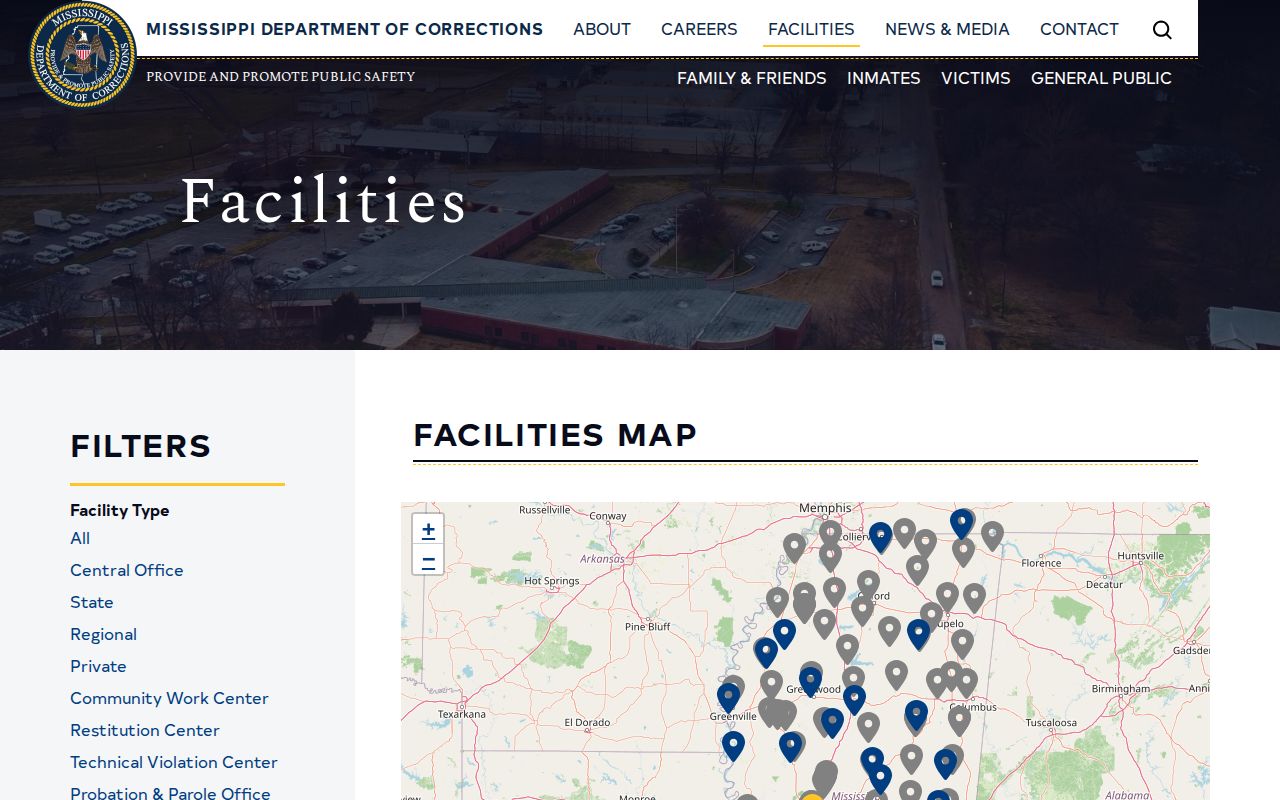
The captured directory supports facility routing. It does not itself prove that a named person was held at, transferred to, or released from any listed institution.
Read MDOC Release Fields
The MDOC detail template can show a photograph, name, MDOC ID, physical descriptors, Entry Date, Location, Unit, Location Change Date, sentence count and length, offenses, sentencing county, and Tentative Release Date. Fields vary by record and status. A future tentative date is a forecast, not proof that release occurred.
An official example in the research showed a Location of South Mississippi Earned Release Supervision and an ERS unit. That is a useful warning: a person can leave a prison facility yet remain an “inmate” under MDOC jurisdiction. The separate parolee search can show county, supervising officer, and Flat Time Date, but flat time is the sentence-end field, not necessarily the physical prison-release date.
- Tentative release date
- A forecast based on information and credit rules then in the system.
- Parole eligibility
- The earliest point for possible Board consideration, not a promised release.
- Actual release
- The executed end of a confinement episode.
- Discharge
- Completion of the identified sentence or supervision term.
Why MDOC Dates Change
Sentence data can change after earned-time awards or forfeitures, disciplinary action, amended commitment papers, concurrent or consecutive sentence review, jail-credit correction, parole action, a detainer, or another legal event. Mississippi's earned-release provisions depend on the offense date, offense type, exclusions, and sentence structure. The familiar 85/15 shorthand is not a universal calculator.
A Parole Board grant is another milestone, not the release timestamp. Conditions and MDOC processing must still be completed. Where timing matters, compare four dates: sentencing or commitment, parole eligibility, tentative release, and actual release or discharge. Only the last executed field proves that the confinement episode ended.
MDOC Inactive Release Archive
MDOC records rules define active and inactive master files for people sentenced to the department. An Inactive Master File can cover those discharged at expiration, released by Supreme Court mandate, or finished with parole, probation, post-release supervision, shock probation, or other supervision. It can remain the strongest historical route when an active public search is unhelpful.
Ask for public, named fields rather than a broad file dump: MDOC ID, custody and location history, actual release or discharge date, release mode, time computation, and discharge certificate. Some content may be exempt or redacted. The rules establish an inactive file category, but the research did not verify a numeric online-retention or destruction period.
Reconcile DeSoto and MDOC Records
A DeSoto court order explains the legal authority behind a sentence or custody change. The ADF record shows how and when the county handed the person off. MDOC records then show state reception, location, sentence administration, supervision, and eventual release or discharge. These sources form a chain, not competing versions of one roster.
Use the booking number, court case number, and MDOC ID to keep episodes aligned. “Bond set” does not mean bond posted. “Transferred to MDOC” does not mean released. A future tentative date does not show an event already occurred. When two custodians differ, ask each to reconcile the exact date or status field and preserve the response.
Mississippi Release Record Requests
Mississippi's Public Records Act generally requires a written explanation when a public body cannot produce by the seventh working day, with production usually no later than fourteen working days absent agreement. Charges are limited to actual search, review, duplication, and mailing costs, and exempt content should be redacted while nonexempt content is produced.
Those rules do not make every correctional detail public. Medical, security-sensitive, victim, personally identifying, active-investigation, sealed, and other protected information may be withheld. Ask for a named existing document and request the legal basis for any redaction. Preserve the request, estimate, response, and produced record so the state release finding can be traced.