
DeSoto County Release Meaning
“Released” describes the end of one custody episode, but it does not always mean the person went home. A defendant may leave the DeSoto County Adult Detention Facility after posting bond, receiving a court order, earning credit for time served, or finishing a county sentence. The Sheriff may instead surrender the person to the Mississippi Department of Corrections, another county, the U.S. Marshals Service, or immigration authorities. That handoff ends DeSoto custody while confinement continues. A precise DeSoto County release record names the authority, time, and destination rather than treating every departure as freedom.
The agency that held the person owns the best proof. The DeSoto County Sheriff keeps the county jail docket and underlying booking and release entries. MDOC holds records for a later state sentence, parole, earned release supervision, or discharge. A court file explains the order that permitted or required release, but the filed order may predate the jail’s actual checkout. VINE reports participating-agency events and alerts. BOP records cover federal terms. Those sources overlap, yet each answers a different part of the release question.
- Time served
- A court credits confinement already completed toward a sentence.
- Parole
- Conditional community release from a prison sentence after Board action and processing.
- Probation
- Court-ordered supervision that may begin without a state-prison term.
- Discharge
- The end of the stated sentence or supervision obligation, as defined by the record.
DeSoto County Release Types
The label on the record controls what can safely be said. Bond keeps the criminal case open. A dismissal resolves the listed charge but may not clear another hold. Transfer and extradition continue custody elsewhere. Parole ends prison confinement under conditions, while a discharge can mark the end of a sentence or supervision. The table shows how common DeSoto County release events change the next search.
| Departure | Meaning | Next record |
|---|---|---|
| Bond or recognizance | The person leaves pretrial custody while the case continues. | Sheriff entry and court bond order |
| Time served or sentence complete | The county term is credited or completed. | Jail entry and judgment |
| Dismissal or court order | The listed charge is resolved or release is directed. | Court order plus executed release |
| MDOC commitment | County custody ends and state custody begins. | MDOC search and records |
| Detainer or extradition | Another agency assumes custody. | Receiving-agency record |
| Parole, ERS, or discharge | A state term moves to supervision or ends. | MDOC or Board record |
A person may pass through several rows. Someone booked in Hernando can be committed to MDOC, later placed on earned release supervision, and eventually discharged. Each date marks a separate event. The DeSoto jail date should not be substituted for the later state release date.
DeSoto County Release Record Fields
A useful record ties one person to one booking episode. Full name and date of birth help identify the person, while a booking number or MDOC number keeps separate custody periods from being mixed. The booked and released times set the span. The release code, releasing authority, and receiving agency explain what occurred next. Charge and bond fields supply context but do not replace a filed disposition.
| Field | What it shows |
|---|---|
| Name and birth date | The identity attached to the episode |
| Booking or MDOC number | The local or state record key |
| Booking date and time | When custody began |
| Release date and time | When that custodian ended physical custody |
| Release type | Bond, order, time served, completion, transfer, parole, or another reason |
| Authority or destination | Who directed the event and whether custody continued |
The public JailTracker view can change and no official DeSoto source promises how long a former booking remains visible. The stored jail-docket entry is the durable item to request. For a state term, obtain MDOC’s executed release or discharge record rather than treating a future tentative date as proof.
Release reason and case outcome also need separate fields. A bond code explains why the jail ended pretrial custody, but the charge may remain open. Time served can satisfy one judgment while another hold stays active. A transfer destination can be more important than the word “release” because it identifies continued custody. For MDOC, the location, unit, sentence entries, and date fields must be read together. For BOP, a historical release date concerns federal custody only. A complete DeSoto County release check therefore preserves the source’s exact label, connects it to the correct identifier, and states what the field does not resolve.
Request DeSoto County Release Records
The Sheriff is the custodian for an ADF booking and release entry. DeSoto County’s policy routes arrest and police records to the agency that created them, while court records go to the clerk. Before sending sensitive identifiers, ask the ADF which channel currently accepts Mississippi Public Records Act requests. A narrow request is easier to identify and price than a broad demand for every record about a name.
- Give the full name, birth date, approximate custody dates, and booking number if known.
- Ask for the existing jail-docket, booking, and release entry, including public time, code, authority, destination, and booking photo.
- Request electronic delivery and a written estimate before costs exceed a limit you choose.
- Ask for the legal basis for any withholding and the release of public parts after redaction.
- Compare the result with the matching court order or receiving-agency record.
3425 Industrial Drive W
Hernando, MS 38632
ADF: 662-469-8566
Inmate information: 662-469-8500
Fax: 662-469-8532
Mississippi Code § 25-61-5 requires a written explanation when production cannot occur by the seventh working day and generally limits a later production date to fourteen working days unless the parties agree otherwise. Section 25-61-7 permits actual search, review, copying, and mailing costs. No fixed DeSoto fee was verified, so ask for the estimate. Protected portions may be restricted.
Keep the request, acknowledgment, cost estimate, produced files, and any exemption citation. If the Sheriff produces a release time that conflicts with the court docket, ask each office about the named field rather than selecting the easier answer. The clerk may have entered an order before ADF processed it. A receiving agency may show intake after the DeSoto checkout. Those timestamps can all be accurate because they mark different steps. Ask for existing documents, not a new narrative, and narrow a multi-day request to a defined start and end time. For MDOC records, use the agency’s public-record route and identify the MDOC number, requested time sheet, release or discharge entry, and date range.
DeSoto County Release Record Law
The Mississippi Code places the Public Records Act in Title 25, Chapter 61. Section 25-61-9 requires a public body to redact exempt content and produce separable public material. The DeSoto County request policy and request form explain routing. A sheriff record and a court record remain distinct even when they describe the same case.
Mississippi expungement law is outcome and offense specific, chiefly within Title 99. Release does not itself create expungement. When a court enters an order, public systems may update at different times. A file-stamped copy can be sent to each custodian through its correction process. No official source promises a fixed online retention period for a former DeSoto booking.
DeSoto’s policy sends judicial records to the clerks instead of treating them as ordinary Board public-record requests. Felony matters generally lead to Circuit Court. Justice Court handles matters within its limited jurisdiction and initial proceedings, while municipal cases may stay with the relevant city court. Youth Court records are restricted. A booking charge and case number help select the right clerk. When the court is unclear, ask which office owns the case number. The most useful filed records include bond and release orders, judgments, sentencing orders, dismissals, revocations, amended sentences, and satisfaction or discharge entries. A certified copy may be needed when formal proof matters.
DeSoto County Bond Release
Bond release is not case completion. The ADF page sends bonding questions to the online jail docket, where charge and bond entries provide the local starting point. A court order shows the amount or terms set by the judge. The Sheriff’s release entry shows whether bond was actually posted and when the jail carried out the release. If another warrant, detainer, or commitment remained, the person might not enter the community even after the DeSoto charge allowed release.
Does “bond set” mean the person left? No. It establishes a court condition, not payment, acceptance, checkout, or the absence of other holds. Confirm the executed release with the Sheriff. Ask about the named booking episode, public release code, actual date and time, and whether any agency assumed custody.
Find DeSoto County Released Inmates
Start with the custodian most likely to hold the episode. A current JailTracker entry can supply the exact spelling, booking number, charges, and bond context. Yet the county calls that product a jail docket, not a historical recent-release archive. A missing result calls for verification, not a conclusion. The following path separates present custody, community release, transfer, and later state or federal status.
- Search the official DeSoto JailTracker docket and save the identifiers shown.
- Call the Sheriff information line or ADF and ask whether that episode ended, when, how, and whether another agency took custody.
- Check Mississippi VINE for a matching participating agency and read release and transfer events literally.
- Use the case number at the proper court source to find the filed authority.
- If the entry names MDOC, USMS, BOP, ICE, or another county, continue with that custodian.
- Request the stored release entry when the live view no longer shows the episode.
The DeSoto County 24-Hour Releases page explains why the live docket is not a verified same-day release feed. For one named person, the sequence above remains the stronger route.
MDOC DeSoto Release Search
The Mississippi Department of Corrections inmate search applies after a DeSoto record shows commitment or transfer to MDOC. It does not cover every short county-jail stay. Search with the narrowest sound identifiers, retain the MDOC number, and compare offense, sentence county, sentence date, descriptors, location, and status. The detail can show the exact field “Tentative Release Date,” which is a projection rather than an executed release.
| Field | Use | Limit |
|---|---|---|
| First name | Narrows surname results | Spelling and aliases vary |
| Last name | Primary name search | Common names need added checks |
| MDOC ID | Links the state record | Not the county booking number |
The official interface appears in the MDOC source shown below.
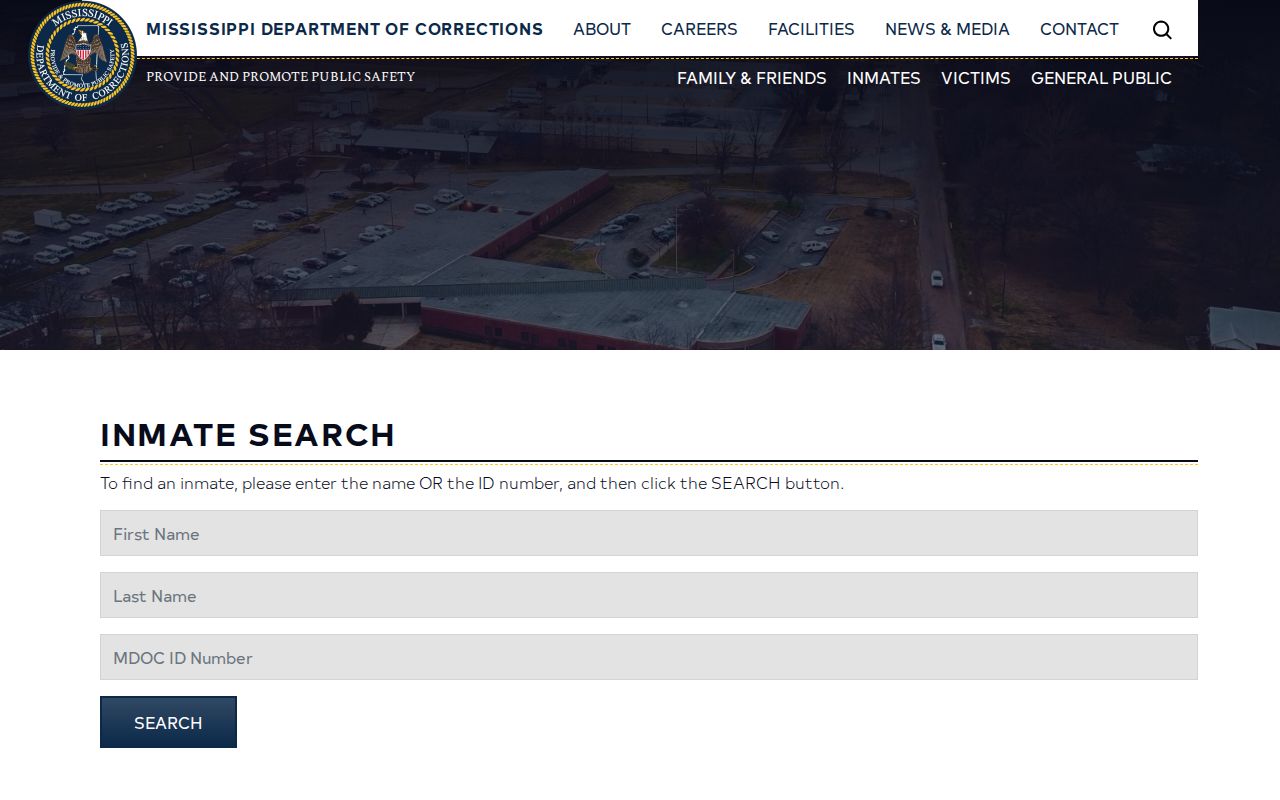
The image shows the state route after an MDOC transfer. A county-only release may never appear there, while an ERS participant can remain under MDOC jurisdiction after leaving a prison.
DeSoto County Recent Releases
No separately advertised official DeSoto 24-hour or 72-hour release list was verified. The facility and Online Records pages call the vendor product a jail docket. They do not promise a release window, update cadence, or length of post-release display. Sorting current bookings must not be relabeled as a recent-release list. For an urgent status, call the ADF. For documentary proof or a three-day set, request existing release-log entries for a specific start and end time.
VINE can corroborate a participating agency’s event, but it is not the sheriff’s legal release entry. The MDOC search applies only when the person moved into state custody. Court files explain why release was allowed or ordered. These are sources with different scopes, not interchangeable versions of one feed.
Note: Save the access date for a dynamic search because the public docket can change without a published retention promise.
DeSoto County Post-Release Supervision
Parole is conditional release from a prison sentence after Mississippi State Parole Board action and MDOC processing. Probation is ordered by a court and may begin without a prison term. MDOC Community Corrections administers supervision. DeSoto’s named local office is the Probation & Parole Office in Hernando, not a prison or county-jail release desk. A local assignment confirms supervision, not the date someone left the ADF.
Use the MDOC inmate or parolee search, match the MDOC ID, read the status, and obtain the Board record if parole is claimed. A favorable hearing decision is not a physical release time. The full local route appears on the DeSoto post-release supervision page.
DeSoto Release Alerts and Federal Records
Mississippi SAVIN/VINE supports person and agency selection, status events, and notification options offered for a matching record. Confirm that the reporting agency and identifiers fit the DeSoto episode. A transfer event means custody may continue. Registration can involve phone or email details and a PIN or confirmation step when offered. VINE may lag and should not be the only source for an urgent decision.
A federal term requires the BOP Inmate Locator. A historical result with a release date and “not in BOP custody” establishes only departure from BOP custody. It does not rule out a county jail, state prison, USMS transport, or immigration detention. The ICE detainee locator focuses on current immigration detention, so a missing result is not proof of release.
DeSoto’s extradition instructions make the transfer risk concrete. An outside agency may send a warrant or detainer to the ADF booking desk, and the Sheriff’s Fugitive Division coordinates pickup. The published procedure ordinarily gives that agency ten business days after DeSoto charges finish to arrange transport, subject to exceptions. The county case can be complete while the person waits for pickup or moves into another jail. Describe that event as a detainer handoff or transfer until the next custodian documents community release. For USMS, use the federal court and proper Marshal channels because BOP may not yet have a designated prisoner record.
The federal route appears in the official BOP locator capture below.
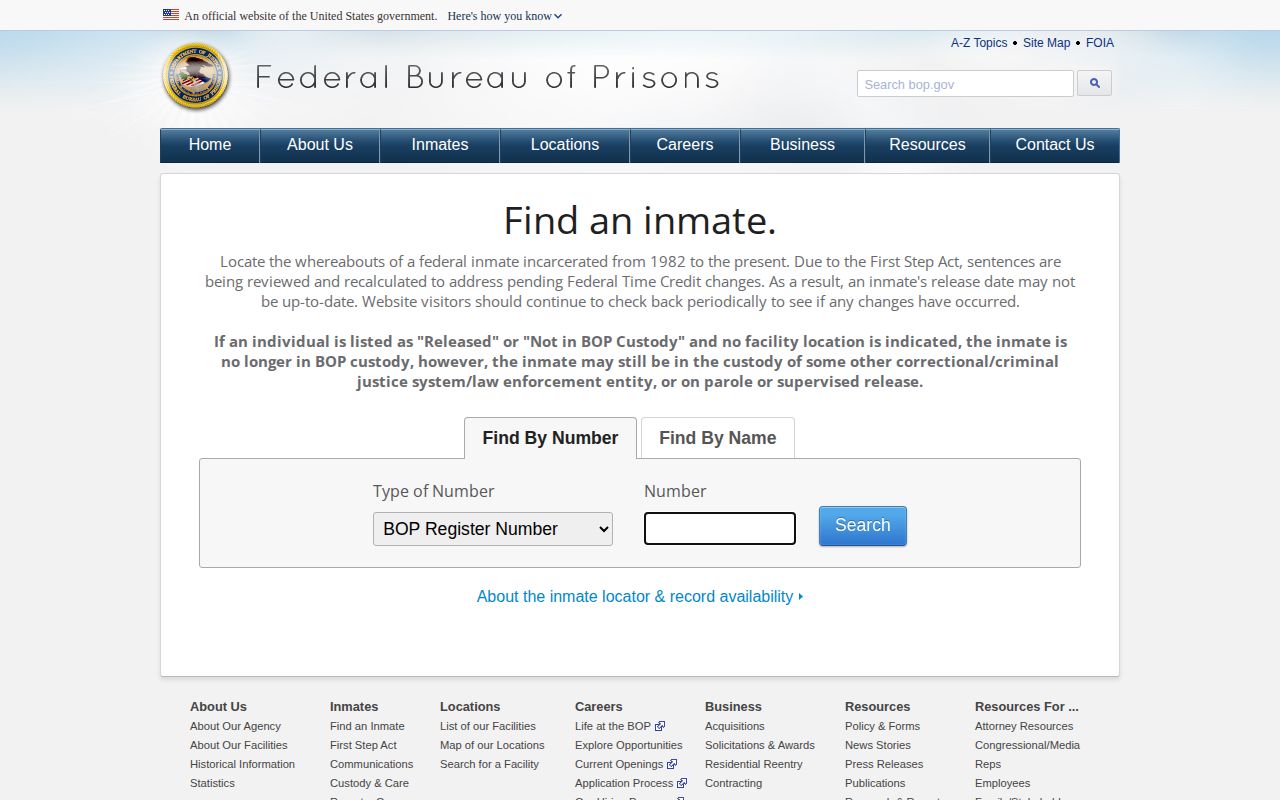
The screenshot represents a federal record path only. Use it after a county or court record points to federal custody.
The Mississippi Sex Offender Registry is another narrow state source, not a general release list. It applies only to people subject to registration law. A matching entry can indicate presence in the community and a registration duty, but it does not supply the executed release record for a jail or prison episode. Absence from the registry says nothing about whether a person was jailed, released, transferred, or discharged. Use the registry only for the population and purpose it covers, and direct local administrative questions to the Sheriff’s registration contact.
DeSoto Release Status Comparison
The right system follows the custodian and time period. A live roster answers a present-tense jail question. A release entry documents the end of that booking. A court order supplies legal authority. State and federal systems begin only after those jurisdictions take control.
| System | Best use | Cannot prove alone |
|---|---|---|
| DeSoto JailTracker | Current docket and booking identifiers | That a missing person reached the community |
| Sheriff release entry | End of a county booking | Later release from a receiving agency |
| Court order | Authority and disposition | Exact jail checkout or no other hold |
| MDOC search | State custody and tentative date | A county-only release |
| VINE | Reported events and alerts | The legal release certificate |
| BOP locator | Federal history and release date | State, local, USMS, or ICE status |
Use identifiers to move between sources. A booking number helps the Sheriff and clerk. An MDOC number connects the state profile, parole record, and records request. A BOP register number narrows the federal locator. Name-only matching is the weakest method.
DeSoto Release Records and Courts
The DeSoto Online Records hub places the Sheriff-maintained jail docket, Circuit Clerk inquiry, and Justice Court case data together. The Sheriff documents the custody episode. The clerk’s file shows the bond order, dismissal, judgment, sentence, revocation, or discharge order. Match them by booking and case number when possible.
Read court verbs with care. “Bond set” does not say bond was posted. An order of release does not eliminate a separate hold. Dismissal or acquittal resolves the listed charge but does not state the hour of checkout. A sentence-satisfied entry can prove completion for that case. The Sheriff or MDOC still establishes when the custodian acted.
The official Circuit Clerk route is shown below.
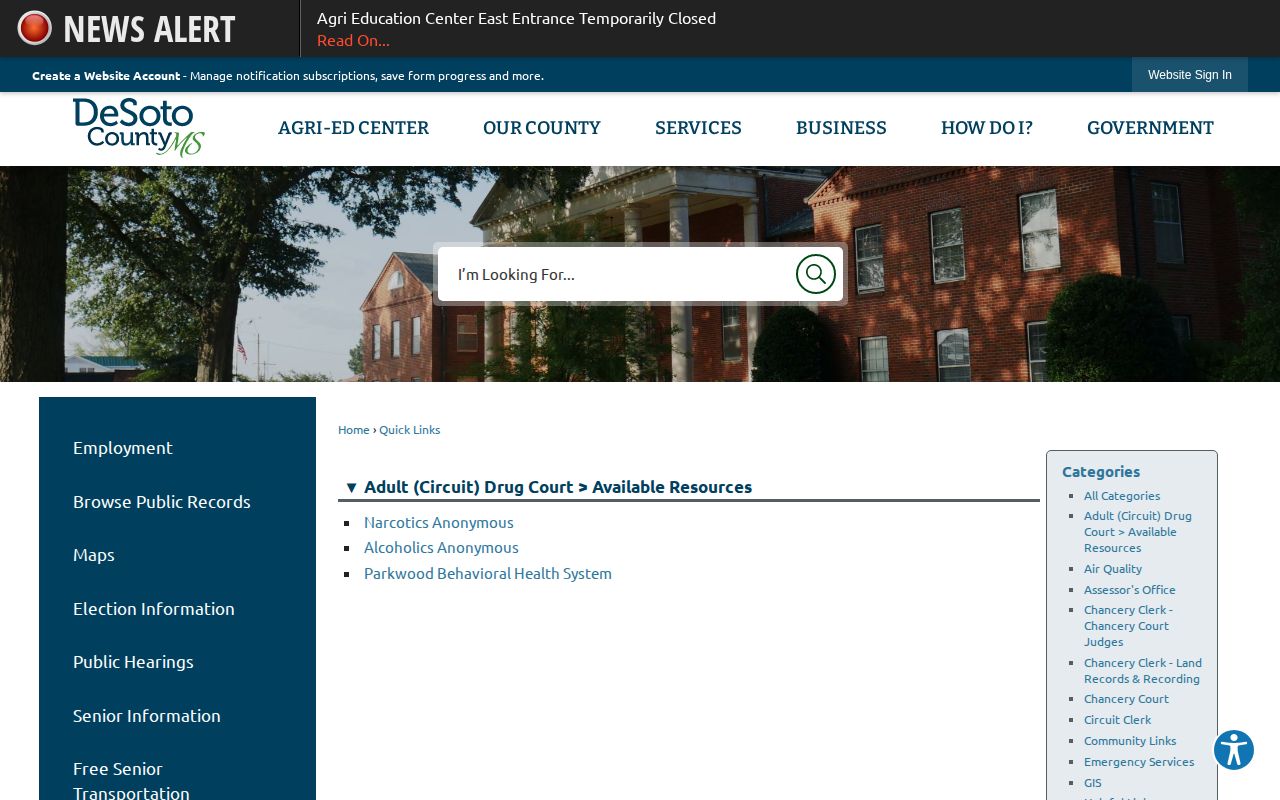
The court source supports the filed-order side of a release check. It does not replace the executed release entry.
DeSoto Jail Release History
DeSoto County states that the present Adult Detention Facility opened in 2012 with 304 beds and expanded in 2015 to 568. The later figure matters because old descriptions may repeat the original capacity. Capacity does not measure releases, and no official annual release total was found. It does identify the correct Hernando facility and explains why two sourced figures refer to different points in its history.
The county’s term “jail docket” also matters. It reflects the Sheriff’s recordkeeping role without promising a release archive. A sound search moves from that changing view to the stored jail-docket entry when history is needed.
Adjacent DeSoto Release Record Offices
The ADF and Justice Court or visitation location sit beside one another on Industrial Drive at separate street numbers. Their proximity can cause a routing error. The Sheriff answers when the jail carried out a release and whether another agency assumed custody. The court clerk supplies the filed order and case disposition. Nearby buildings do not merge those duties.
Call before visiting and name the record sought. Ask the ADF for the booking and release entry. Ask the clerk for a filed order or certified docket copy. If the matter later moved to MDOC, ask MDOC for its own time computation or discharge record. This division avoids delay and keeps one office from being asked to create an answer held by another.
DeSoto Release Property and Files
The current ADF handbook distinguishes a transferred prisoner’s personal property from commissary left behind. It calls for a property-release form and an authorized recipient. Unclaimed personal property has a stated 30-day disposal point, while commissary has a separate 14-day rule. Those deadlines concern property, not legal release status, but they can matter soon after a transfer or release.
A different record can remain after state supervision ends. MDOC rules describe an Inactive Master File for a completed matter that may be obtained by written request. That offers a route when an active public search is no longer helpful. Provide the MDOC number, full name, birth date, and date range, then ask for the specific release, discharge, or time-computation document.
Note: Keep property requests and release-record requests separate so the ADF can route each item to the staff that holds it.
DeSoto County Release Facilities
The facility map includes detention sites and follow-on systems because a person can move beyond the county without entering the community. Each link uses the record route tied to that facility type.
- DeSoto County Adult Detention Facility: county jail and local release-record source.
- DeSoto County Juvenile Justice Facility: restricted youth system outside the adult name search.
- DeSoto Probation & Parole Office: community corrections, not a jail.
- MDOC institutions and regional facilities: statewide route after commitment.
- Federal Bureau of Prisons institutions: federal history and release route.
A true release from one system may still leave another system active. Confirm the release reason and receiving agency before describing the person as free from all custody.